Transporting America: Current Policies Shaping Nation-Wide School Transportation
October 21, 2025 · Arya
The State of School Transportation
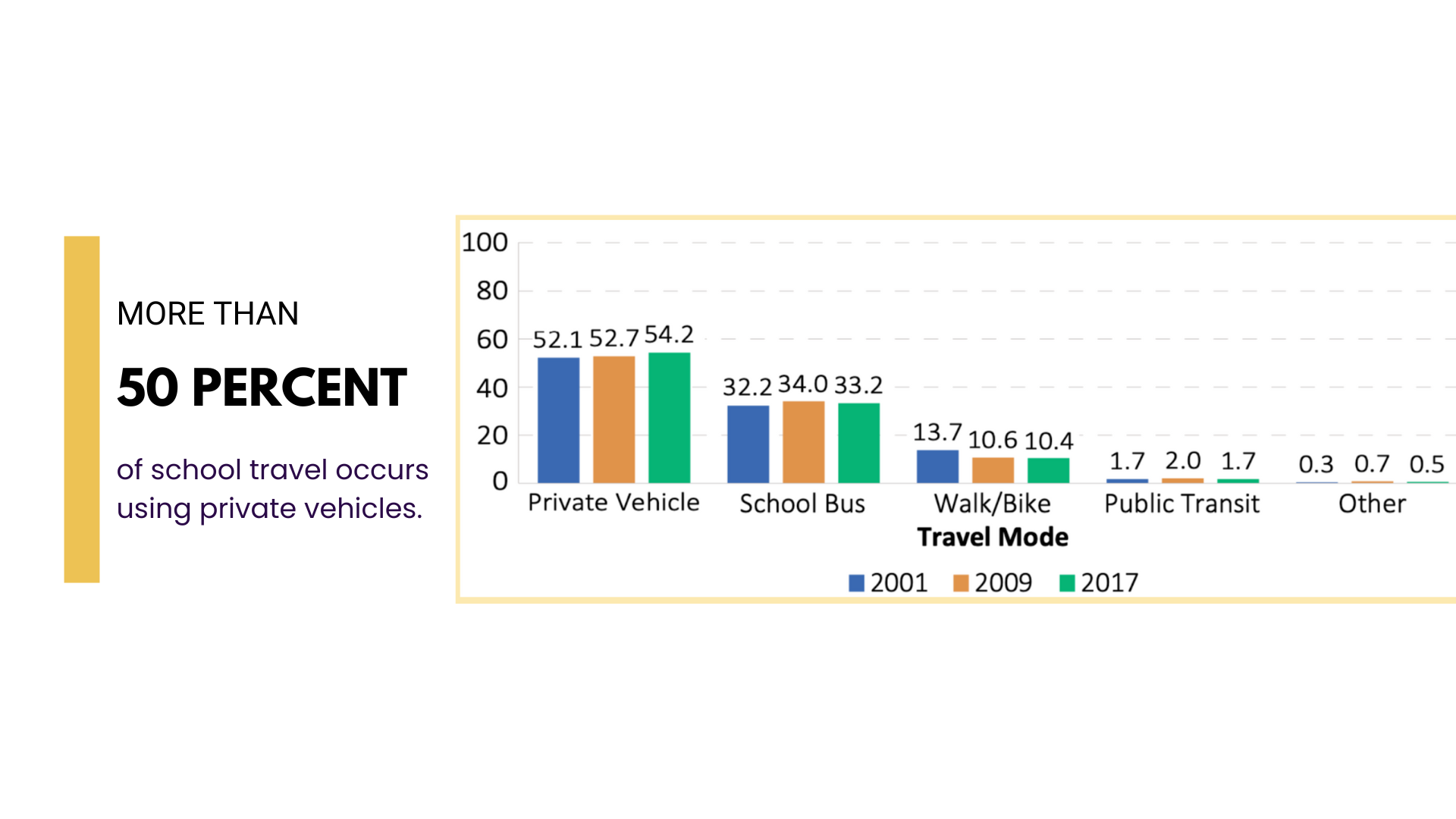
Over 25 million students, or 55.3% of the US public student population, ride one of 475,000 school buses each day. This is a decline from a high of 60% in the 1980s. This decline can be attributed to modern social and policy challenges.
School choice programs
School choice programs allow funds for students to follow them to institutions that they and their families choose, whether it's a public, charter, magnet, or private school. With more school systems moving from the traditional system of assignment based on geographic location and towards school choice, busing is no longer confined to a specific small zone of students, rather having to reach across cities and counties. This increases private vehicle use. A study in Eugene, Oregon, showed that students attending choice schools were more likely to be driven to school.
As students opt to attend schools outside of their immediate neighborhoods, transportation routes become more complex and costly to manage. This is compounded by the hurdles districts already face: a shortage of bus drivers, bus-ride harassment and bullying, accommodations for students with special needs. A full school choice system threatens to increase transportation costs by almost $200 per pupil, an increase of 34 percent, seen in New Orleans by Tulane University researchers.
This trend disproportionately affects marginalized communities, particularly BIPOC and low-income populations, who face greater barriers to accessing preferred schools. This leads to a cycle where districts with the most BIPOC students receive substantially less revenue — as much as $2,700 per student.
Policy changes such as enrollment zones that give students a range of options within one geographical area are proving to be promising solutions. Ridesharing companies are also starting to make a surge in areas especially impacted by complicated school-choice programs, though these services are usually high-cost providers that cities cannot use at scale.
School consolidations
Hand in hand with school choice programs, school consolidation programs tend to collapse smaller schools and districts into one bigger school or district. In the past fifty years, the number of public school districts has declined drastically in the United States, from over 40,000 to under 14,000. This ultimately leads to the same issues as school choice programs and has an additional equity problem.
With school consolidation, base schools can start being placed further away from students, leading to another complex routing and funding problem for buses. This has the additional aspect of "geography of opportunity", as these transport barriers influence the opportunity gap. The quality of schools tends to generally increase the further away from rural, low-income, and minority neighborhoods, meaning the transportation disparity is largest for those neighborhoods.
Transportation regulation
The regulation of transportation systems encounters multiple challenges stemming from the involvement of various levels of government, each with its own set of regulations and policy priorities. Local, state, and federal governments may have different ideals for transportation. Funding limitations necessitate complicated trade-offs regarding resource allocation.
Rising operational costs, coupled with evolving transportation needs and logistical challenges, have led many school districts to explore alternative cost-saving measures, such as transportation fees or outsourcing to private operators. Additionally, concerns voiced by parents and guardians regarding the safety and reliability of transportation options complicate the process of standardizing regulations.
The bus industry maintains yellow buses are the safest and limit the amount of students walking and being exposed to traffic. However, peer reviewed research hasn't proved any substantial difference from regular public transit in terms of safety, posing a dilemma for school districts when faced with the fact that returning to in-house services would be 15–20% less expensive.
Public transit
Amidst growing concerns over traffic congestion, environmental sustainability, and equitable access to transportation, there is increasing emphasis on investing in public transit infrastructure. This investment aims to bridge the disparity in "geography of opportunity" by reaching out to residents of isolated neighborhoods.
It's worth noting that the legal framework surrounding student transportation varies widely across the US, with differing reimbursement programs, bus mandates, and regulations. An ever-present measure is the Tripper rule, which restricts the use of federal transit funds for student transportation in order to preserve states' rights and the private busing industry.
Certain case studies exemplify public transportation solutions to busing. In Oakland, California, a subsidized youth bus pass program offers a transportation option for students. However, only 23% are estimated to utilize the program compared to the country-wide average of 55.3%. In Washington, D.C., efforts to subsidize student transportation costs during commuting hours have yielded positive outcomes. Portland, Oregon has implemented completely free bus passes for students.
A public transport solution comes with its own challenges, however. Firstly, the degree of subsidy varies wildly across the country. Furthermore, all this must carefully cater to Tripper law loopholes. Additionally, research in New York shows that the average commute to school increased from 15 minutes to 29 minutes with the use of public transit. In cities like Denver and DC with strong public transportation systems, as many as 67% of Denver parents and 43% of DC parents drive their kids to school.
Conclusion
School busing serves as a large component of the transportation of America's schoolchildren. However, the complex landscape of school transportation in the United States reflects broader societal trends and policy challenges. The decline in school bus ridership, driven by burgeoning school choice programs, financial/regulatory challenges, and school consolidations, has exacerbated transportation inequities, particularly for marginalized communities.
Ultimately, achieving equitable student transportation requires efficient policy frameworks within school systems and innovative solutions.
References
- Gross, B. (2019, August 6). Going the Extra Mile for School Choice. Education Next.
- Meko, T. (2017, February 2). Student Transportation and Educational Access. Urban Institute.
- School Districts That Serve Students of Color Receive Significantly Less Funding. (2022, December 8). The Education Trust.
- Smith, S. A., & Zimmer, R. (2022, February). The Impacts of School District Consolidation on Rural Communities. EdWorkingPapers.
- Vincent, Jeffrey M., et al. 2014. Beyond the Yellow Bus: Promising Practices for Maximizing Access to Opportunity Through Innovations in Student Transportation. Center for Cities + Schools, UC Berkeley.
- What is School Choice? (n.d.). EdChoice.
- Yang, Y., Abbott, S., & Schlossberg, M. (2012). The influence of school choice policy on active school commuting.